


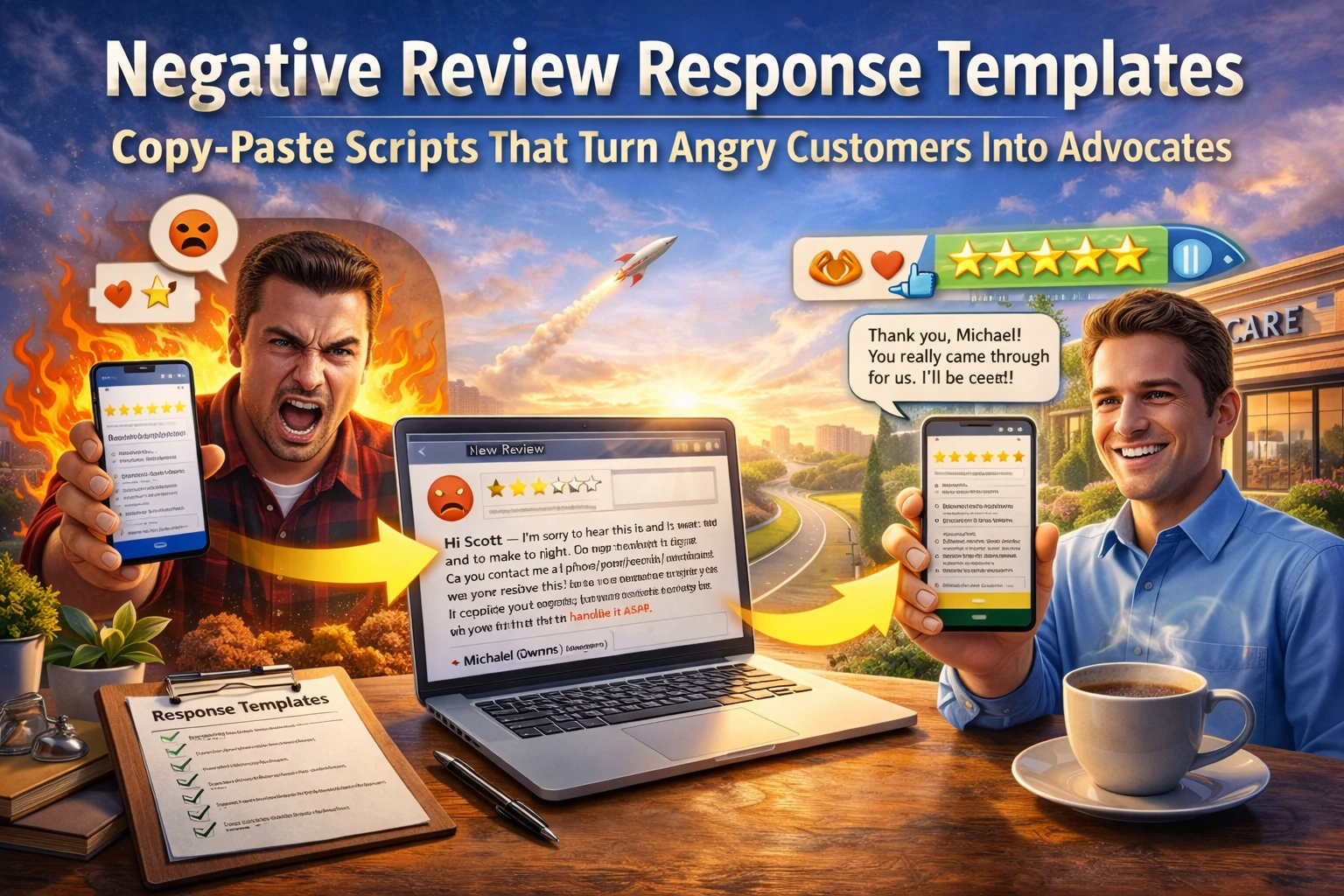
Negative Review Response Templates: Copy-Paste Scripts That Turn Angry Customers Into Advocates
A negative review feels personal. However, it isn’t just a complaint. It’s a stage.
Because you’re not only replying to one angry customer—you’re speaking to every future customer who will read that exchange and decide whether you’re trustworthy.
The surprising truth is this: a well-handled 1-star review can sell your business better than a dozen 5-star ones. It proves you’re calm under pressure, accountable, and willing to fix problems.
Below is a set of copy-paste templates (public + private) you can start using today—plus a simple system for turning “never again” into “they made it right.”
The non-negotiables before you copy-paste anything
1) Don’t “buy” or “trade” for platform reviews
If your business uses perks, freebies, discounts, or “service swaps,” be careful how you apply them.
Platform-safe reminder:
Google policies prohibit incentivizing reviews. Yelp discourages asking for reviews and penalizes solicitation. For social testimonials, if there’s a material connection (free/discounted services, perks), clear disclosure is expected.
Helpful references: Google user-contributed content policy, Yelp: Don’t Ask for Reviews, FTC: Disclosures 101.
The safe lane: reward customers for being customers or for private feedback, then keep any public review requests platform-safe.
2) Don’t argue facts in public
Even when you’re right, “winning” in public makes you look unsafe.
3) Don’t reveal personal details
No receipts. No addresses. No private messages. Keep it general.
4) Keep it short
Your response is not a courtroom. It’s a confidence signal.
5) Offer a next step that doesn’t require begging
Your goal isn’t “please change your review.” Your goal is: resolve + demonstrate character.
The 5-part response formula (use this everywhere)
A.C.T.I.O.N.
- Acknowledge the issue (and their emotion)
- Confirm you take it seriously
- Take responsibility for what you can (without self-incrimination theater)
- Invite them offline with a clear path (phone/email + who to ask for)
- Outcome promise: what you’ll do next / what changed
Once you internalize this, templates become plug-and-play.
Copy-Paste Templates (Public Replies)
Use these on Google. Use them on Yelp carefully. Use them anywhere reviews are visible.
Template 1: The “Classic Service Miss” (late, slow, dropped the ball)
Public reply:
Hi [Name] — I’m sorry your experience was frustrating. That’s not the standard we aim for, and we take this seriously. If you’re open to it, I’d like to understand what happened and make it right. Please contact me at [phone/email] and ask for [manager name]. We’re also reviewing [process area] this week so this doesn’t repeat.
Best when: delays, miscommunication, “they didn’t care,” general dissatisfaction.
Template 2: The “Pricing Surprise” (felt overcharged, unexpected fees)
Public reply:
Hi [Name] — I’m sorry the pricing felt unclear. We never want anyone to feel surprised at checkout. If you can reach out to [phone/email] with the date of your visit and the name on the order, I’ll review it personally. We’re also updating how we explain [estimates/fees/options] up front so it’s simpler and more transparent.
Best when: “hidden fees,” “bait and switch,” “not worth it.”
Template 3: The “Quality Issue” (product/service didn’t meet expectations)
Public reply:
Hi [Name] — thanks for sharing this. I’m sorry the result wasn’t what you expected. We’d like the chance to fix it. Please contact [phone/email] and ask for [name], and we’ll walk through what happened and the best solution. We’re also addressing [specific quality checkpoint] to prevent this going forward.
Best when: “poor work,” “came out wrong,” “not as described.”
Template 4: The “Staff Rudeness” complaint (high emotion)
Public reply:
Hi [Name] — I’m sorry you were made to feel disrespected. That’s never acceptable. I’d like to look into this quickly. Please reach out to [phone/email] with the time/day you visited and I’ll follow up directly. We’re reinforcing our service standards with the team this week.
Best when: “rude,” “dismissive,” “unprofessional.”
Template 5: The “We Messed Up, and We Own It” response
Public reply:
Hi [Name] — you’re right to be upset, and I’m sorry we missed the mark. We’re taking responsibility for this and want to fix it. Please contact [phone/email] and ask for [name]. We’ve also already changed [one concrete thing] so this doesn’t happen again.
Best when: you know you’re at fault. This one earns trust fast.
Template 6: The “Not Our Customer / Wrong Business” (possible mistaken identity)
Public reply:
Hi [Name] — I’m sorry to hear this, and I want to help. I’m not finding a record that matches your details, so it’s possible this was meant for a different business with a similar name. If you contact [phone/email] with the date and what you purchased, I’ll investigate right away.
Best when: mistaken identity or unclear details. Stay calm.
Template 7: The “Unreasonable Demands / Vague Attack” review (don’t take the bait)
Public reply:
Hi [Name] — I’m sorry your experience didn’t meet expectations. We take all feedback seriously, and we’d like to understand the specifics so we can improve. Please reach out to [phone/email] with the date/time of your visit so we can review what happened.
Best when: aggressive tone, vague accusations, “worst ever” with no details.
Copy-Paste Templates (Private Messages)
These are the messages that actually convert anger into advocacy.
Template 8: The “Fast De-escalation” DM / email
Hi [Name], I’m [Your Name], the [Owner/Manager]. I saw your review and I’m genuinely sorry you had that experience. If you’re willing, I’d like to hear what happened and make it right. What’s the best number to reach you, or would you prefer email? Either way, I’ll take care of this personally.
Key: short, respectful, gives control back.
Template 9: The “Make-It-Right Offer” (clear, specific, not defensive)
Thank you for the details. Here’s what I can do right now: [specific remedy—redo, replacement, refund, credit, appointment priority]. If that works for you, I can schedule it for [two options]. If not, tell me what a fair outcome looks like and I’ll do my best to meet it.
Key: you’re proposing action, not pleading.
Template 10: The “We Changed Something” follow-up (this creates advocates)
Quick update: based on what you shared, we’ve already changed [specific step] so the next customer doesn’t go through the same thing. I appreciate you taking the time to tell us—this feedback genuinely helped.
Key: people love knowing their frustration wasn’t wasted.
Template 11: The “Second Chance” invitation (without begging)
If you’re open to it, I’d like to invite you back and give you the experience you should’ve had the first time. I’ll personally make sure it’s handled correctly. Would [date/time option A] or [option B] work?
Key: you’re offering leadership attention, not discounts-for-forgiveness.
Platform-Specific Notes (so you don’t accidentally create problems)
Keep responses professional, short, and focused on resolution. Avoid anything that looks like “review trading.”
Good: “Contact us and we’ll fix it.”
Bad: “We’ll give you [free thing] if you update your review.”
Yelp
Use Yelp replies to show professionalism and invite resolution—without “please review us” language.
Reply briefly in comments (calm, helpful), move details to DM, and disclose perks clearly when a post/testimonial involves a free or discounted service.
The “Advocate Flip” playbook (15 minutes a day)
If you want a repeatable workflow, use this:
- Triage in 60 seconds: Is it real? Is it serious? Is it safety/legal?
- Respond publicly within 24–48 hours: Calm tone, short, invites offline help.
- Message privately within 2 hours (business hours): Use Template 8 and ask for details.
- Resolve with a clear remedy: Put the remedy in writing.
- Follow up with “we changed something”: Template 10 is the advocacy engine.
Where our service fits (without crossing the line)
Your service is built around “swapping value” to accelerate reputation growth across Google, Yelp, and Instagram. The modern, safer way to position that is:
- Swap value for private feedback (survey completion, service-quality check-in, customer appreciation).
- Then run a compliant review workflow:
- Google: make leaving an honest review easy (no incentives attached).
- Yelp: focus on experience + visibility, not solicitation.
- Instagram: build positive proof, and disclose when perks are involved.
That approach protects your listings and still delivers what businesses want: more feedback, better responses, and stronger trust signals.
Final reminder: your reply is for the silent audience
The angry customer might never come back. But the next 1,000 readers are deciding if you’re safe.
So reply like a leader: calm, accountable, action-focused.